

Batteaux and Banjos
Census Analysis: Free and Slave Schedules for Buckingham County, Virginia, 1850
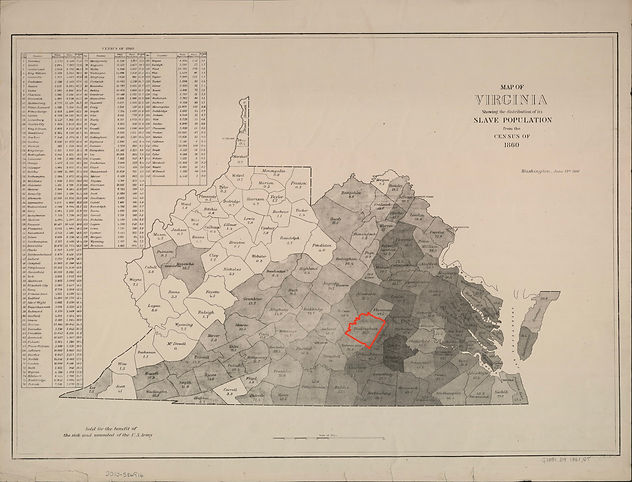
d
I. STATISTICS OF VIRGINIA
for Buckingham County

Population
Total: 13,837
White: 5,426 (39%)
Colored: 8,411 (61%)
(8,161 slave, 250 free)
Land
Farms: 616
Acres improved: 141,536
Acres unimproved:: 166,342
Value with improvements and implements: $2,063,151
Livestock
Horse, asses, and mules: 2,575
Neat cattle: 8,144
Sheep: 11,305
Swine: 15,146
Produce
Tobacco: 2,342,987 lbs
Ginned cotton: 800 lbs
Wool: 24,077 lbs
Indian Corn: 304,711 bushels
Rye: 250 bushels
Oats: 117,091 bushels
Wheat: 133,819 bushels
Hay: 525 tons
Peas and Beans: 4,143 bushels
Irish Potatoes: 17,108 bushels
Sweet Potatoes: 13,425 bushels
Buckwheat: 332 bushels
Wine: 15 gallons
Butter: 83,480 lbs
Flax: 9,434 lbs
Flaxseed: 592 bushels
Beeswax and Honey: 4,224 lbs
Churches
8 Baptist, 4,500 aggregate accomodations
7 Methodist, 2,800 " "
3 Presbyterian, 1,600 " "
1 Episcopal, 500 " "
Education
Public schools: 14, with 14 teachers and 194 pupils*
Academies and other schools: 3, with 9 teachers and 96 pupils
Children attending school during the year as reported by families: 853
Adults who cannot read and write: 495 White, 73 Free Colored**
*State organized and funded public education as we know it today was not instituted in Virginia until 1869 during Reconstruction. The “public” schools of antebellum Virginia, commonly known as “old field schools” were privately organized and funded in local communities.
**The census gives no literacy rate for slaves. In all likelihood the vast marjority were illiterate. However, it is equally likely that a large portion of those classified as literate had only the barest ability to read and write.
II. FREE SCHEDULES

Occupations
The numbers below reflect only those persons for whom the census takers chose to record occupations. While some localities were more comprehensive in their record taking, Buckingham County’s administrators recorded occupations for male heads of households only. Although the list is not comprehensive in this respect, it provides a fair profile of society in Buckingham County at the time. We can be certain that a wide variety of essential jobs were performed by many for whom no occupation is given, especially women who would have been engaged primarily in domestic and agricultural work, with some even operating small businesses of their own. In the neighboring counties of Appomattox and Cumberland we know of at least two seamstresses who owned shops for example. It is also probable that many more persons would have been involved in agriculture that those listed as “farmers.” Besides the many children who would have helped on the family farm, many kept gardens or farms, and some even ran entire plantations, in addition to their listed trade or profession. Many are also likely to have had skills in addition to their listed occupation. For example, it would not have been unusual for a farmer to have some basic blacksmithing and carpentry skills. “Laborer” can also encompass a wide range of menial or even moderately skilled occupations ranging from agricultural jobs to boating, canal work, mining, lumber, foundry work, and etc.. Likewise, “merchant” may indicate trade in a wide range of commodities. It is likely many specialized in particular products, such as tobacco, lumber, cloth, etc. Lastly, there would undoubtedly have been many more skilled laborers, such as carpenters, blacksmiths, masons, weavers, etc., among the county’s even larger slave population.
Farmer: 940
Labourer: 220
Carpenter: 61
Overseer: 51
Merchant: 50
Blacksmith: 35
Pauper: 35
Student: 33*
Physician: 24
Miller: 22
Teacher: 22
Wheelwright: 19
Miner: 14
Clergyman: 13
Lawyer: 13
Mechanic: 12
Shoemaker: 12
Stone Mason: 12
Coach/Carriage maker: 11
Tailor: 11
Boatman/Waterman: 10
Cooper: 9
Sadler: 7
Clerk: 5
Brick Layer: 3
Engineer: 5
Gold Miner: 3
Grocer: 3
Tanner: 3
Ditcher (canal worker): 2
Pedlar: 2
Store keeper: 2
Tavern Keeper: 2
Boat/boot maker(?): 1
Dentist: 1
Foundry Master: 1
Gardener: 1
Hatter: 1
Hotel Keeper: 3
House Joiner: 1
Lumber Master: 1
Post Master: 1
Surveyor: 1
*Plus approximately 50 students at Buckingham Female Collegiate Institute. Although some of these would have been girls from Buckingham families, many came from other parts of Virginia and across the South.
56 free persons of color, “black” and “mulatto” are included in the list above with the following occupations:
Stone mason: 5
Shoemaker: 5
Wheelwright: 1
Farmer: 6
Labourer: 27
Carpenter: 5
Ditcher: 1
Boatman: 5
Blacksmith: 1
The official census records distinguish between “black” and “mulatto.” Of the 56 persons listed above, 7 are listed as “mulatto.” For simplicity’s sake, they have been combined here. The Free Schedules of Buckingham County indicate a handful of households which appear to be mixed race.
The census gives an official tally of 71 free residents of Buckingham born out of state, with 42 of those born in the United States and 29 in foreign countries. Meanwhile the Free Schedules indicate 61 persons born out of state, including parents and children, with the following places of birth:
Alabama: 3
England: 13
Germany: 3
Illinois ?: 1
Ireland: 6
Kentucky: 1 (child)
Maine: 2
Maryland: 2
Mississippi: 3
New York: 6
North Carolina: 13
Pennsylvania: 5
Vermont: 2
Wales: 1
Persons from Alabama and Mississippi are young children of Virginia-born parents, indicating a family which has moved from Virginia to those states, had children there, and returned to Virginia.
Listed occupations of non-Virginia natives:
England: 2 engineers, 1 mechanic, 5 miners, 1 farmer, 1 gold miner
Germany: 1 pedlar, 1 miner, 1 merchant
Ireland: 1 gardener (Waterford, Ireland), 3 farmers, 1 blind
Maine: 1 mechanic, 1 physician
Maryland: 1 mechanic, 1 labourer
North Carolina: 1 mechanic, 2 miners, 6 students
New York: 3 miners, 1 farmer
Pennsylvania: 1 shoemaker, 1 Methodist clergyman, 1 miner, 2 engineers
Vermont: 1 merchant, 1 mechanic
Wales: 1 miner
III. SLAVE SCHEDULES

According to the 1850 census, 13% of Buckingham County’s white residents owned slaves, or 703 out of a total white population of 5,426. By comparison, the percentage of slaveowners out of the total white/free population of the slave states as a whole was only 5.6%. Because owners were generally heads of households, a more valuable figure is the percentage of slaveholding families. It is estimated that somewhere between 25% to a third of all Southern families owned at least one slave. With 703 slaveowners and total of 1,062 white and free colored households recorded in the 1850 census, the figure for Buckingham County would have been closer to 50% of families owning at least one slave. This percentage much be much higher if we were to assume that slave owners were exclusively heads of households. However, the fact that slave ownership tended to be concentrated in certain families more than others, with many siblings and husband and wife couples owning slaves independently of one another, reduces our estimate.

d
Buckingham’s four largest slaveholders in 1850
Edmund Wilcox Hubard: 82 slaves
Charles Yancey: 98 slaves
Martha B. Eppes: 92 slaves
Thomas M. Bondurant: 111 slaves
Sources
Census of 1850, Statistics of Virginia:
https://www2.census.gov/library/publications/decennial/1850/1850a/1850a-28.pdf
Free Schedules Seventh Census of the United States, 1850, Reel 937:
https://archive.org/details/populationschedu0937unix/page/n415/mode/2u
Slave Schedules of Virgina, Seventh Census of the United States, 1850, Reel 984:
https://archive.org/details/populationschedu0984unix/page/n397/mode/2up